Gum Arabic vs. Synthetic Binders: Small-Scale Experiments with Ground Color
Why compare binders?
Binders determine how pigment particles stick together and to support, how a paint film behaves when dry, and how the colour reads. Gum arabic is a traditional binder for watercolour and some gouaches; synthetic binders appear in modern acrylics and half-gouaches. Comparing them with the same ground pigment clarifies how much difference the binder alone makes to gloss, body, and reactivity.
Experiment setup
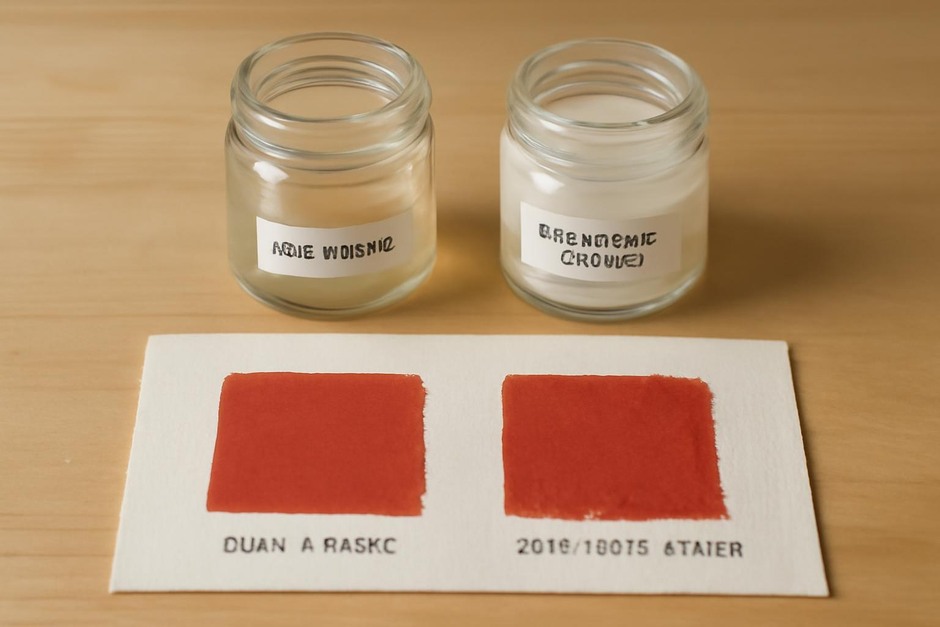
Use a single pigment ground to a consistent paste and split it into two equal portions by weight. Mix one portion with a measured fluid solution of gum arabic and the other with a measured amount of a neutral synthetic binder solution. Keep pigment-to-binder ratios identical and apply three standard tests on the same paper: a thin wash, a medium wash, and a thick impasto-like stroke. Allow full drying and then test rewetting, glazing, and surface sheen.
Initial wet handling
Gum arabic tends to create mixes with a slightly more lubricious surface when diluted; brush glide is soft, and edges feather predictably. Synthetic binders often provide more body and slightly more resistance under the brush at the same apparent dilution. This can be helpful for strokes that hold tooth or slight relief.
Dry film and sheen
Drying behaviour diverges: gum arabic generally dries to a matte to satin finish depending on concentration and pigment, while synthetic binders more commonly dry to a satin to glossier surface. The perceived depth of colour may shift with sheen; gloss can make colours appear denser and more saturated. Observe the same mixed values under natural, diffused light to note differences without glare.
Reworkability and glazing
Surfaces bound with gum arabic are often more easily reactivated with water, allowing lifts and softening over a longer time window. This supports gradual glazing and subtle corrections. Synthetic binders can be less reactive after drying, so lifting is more limited; glazing layers may sit clearer on the surface and stack with less disruption to lower layers, which can be an advantage for controlled glazing sequences.
Durability and surface feel
Synthetic binders can provide increased film strength and resistance to mechanical abrasion when dry. Gum arabic films are flexible but can be more susceptible to scuffing in some contexts. For objects and surfaces that will be touched repeatedly, binder choice influences longevity in predictable ways.
Practical considerations
- Visual edges: choose gum arabic for more forgiving rework and soft transitions; choose synthetic binders for layered clarity and less absorbent top layers.
- Colour depth: sheen from synthetic binders can increase perceived saturation; matte gum arabic leans toward a softer, more powdery appearance.
- Handling: gum arabic mixes often require more frequent stirring and careful storage to prevent skinning; synthetic mixes can be more stable in open jars but vary by formulation.
These notes are meant to show how binder shifts decisions in a studio. For studies that rely on reactivation and subtle lift, gum arabic may be more congenial. For stacked glazing where discrete layers are preferred, a synthetic binder might offer clearer separation. Testing with the pigments and supports you use most often builds practical familiarity—recording results in a small notebook helps make those choices repeatable.